The Promise of Portable Labs
The idea is simple.
Shrink a laboratory into a handheld device.
Advances in microfabrication and nanotechnology have made it possible to integrate complex analysis into a single chip. The result is faster diagnostics, real-time data, and reduced reliance on centralized labs.
This shift is already visible in everyday tools, from pregnancy tests to COVID-19 diagnostics.
But the real impact goes further.
Portable labs enable:
- on-site decision-making
- faster response times
- more efficient resource allocation
The technology works.
Turning it into a product is where things become difficult.
Why Productization Is the Real Challenge
A working chip is not a product.
It is a component.
The challenge lies in integrating complex sensing technologies into devices that people can actually use in uncontrolled environments.
Portable lab devices must balance:
- precision and reliability
- environmental resistance
- usability for non-experts
- regulatory compliance
Each of these introduces trade-offs.
Improving one often complicates another.
Case Studies: From Technology to Product
Real-world projects highlight how these challenges play out.
NeoSpectra: Grain Analysis in the Field
Client: Si-Ware Systems https://www.si-ware.com/
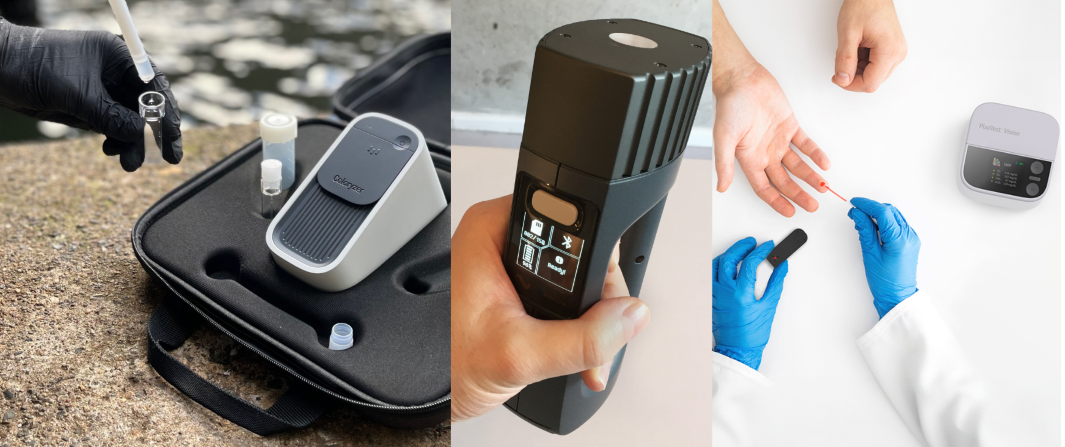
This handheld analyzer uses MEMS-based spectroscopy to assess grain quality.
The challenge was thermal stability. The sensors required controlled temperatures, while the device needed to operate in harsh agricultural environments.
The solution involved careful thermal management without compromising durability, ergonomics, or usability.
Coloryzer: Accurate Water Analysis
Client: Ayxon-Dynamic https://www.coloryzer.com/
Optical colorimetry requires controlled lighting conditions.
The challenge was to achieve laboratory-level darkness in a portable device.
The solution was a magnetic sliding mechanism that ensured consistent measurement conditions while remaining intuitive and easy to use.
PixoTest: At-Home Diagnostics
Client: iXensor https://www.ixensor.com/ixensor_web/
These devices transform smartphones into diagnostic tools.
The challenge was variability. Different phone designs, user behaviors, and contexts required a flexible solution.
The result was an adaptive design system that maintained usability across devices while enabling reliable diagnostics.
What Makes These Devices Work in the Real World
Across different applications, the same core challenges appear.
Environmental Control
Laboratory conditions are stable.
Real-world environments are not.
Devices must account for temperature, humidity, dust, and unpredictable usage.
Usability for Non-Experts
These devices are no longer used only by trained professionals.
They must be intuitive, clear, and error-resistant.
Early User Testing
Assumptions about usability often fail.
Testing with real users early helps identify friction points before they become costly problems.
Compliance
Certification requirements influence design decisions from the start.
Delaying compliance leads to redesign and delays.
From Prototype to Production
Prototyping is not about proving success.
It is about uncovering failure.
Each prototype should answer a specific question, whether technical, usability-related, or commercial.
A pilot run then validates the full system under real production conditions.
This includes:
- manufacturing processes
- quality control procedures
- supply chain alignment
Without this step, scaling introduces risk.
The Reality of Mass Production
Even with preparation, challenges remain.
Consistency becomes critical.
Component shortages, supplier variability, and production deviations can impact quality.
Strong quality control systems and clear processes are essential to maintain reliability at scale.
Conclusion
Portable lab technology has enormous potential.
But the technology alone is not enough.
Success depends on the ability to turn complex systems into products that work reliably, intuitively, and consistently in the real world.
That is where most projects succeed or fail.