
Introducing CellAED
The CellAED is the world’s first handheld, smart, personal automated external defibrillator.
It is designed to bring life-saving technology out of clinical environments and into homes, workplaces, and public spaces.
By making defibrillation more accessible, the product aims to improve response times in cases of sudden cardiac arrest, where immediate action can make the difference between life and death.
Designing for Real-Life Emergencies
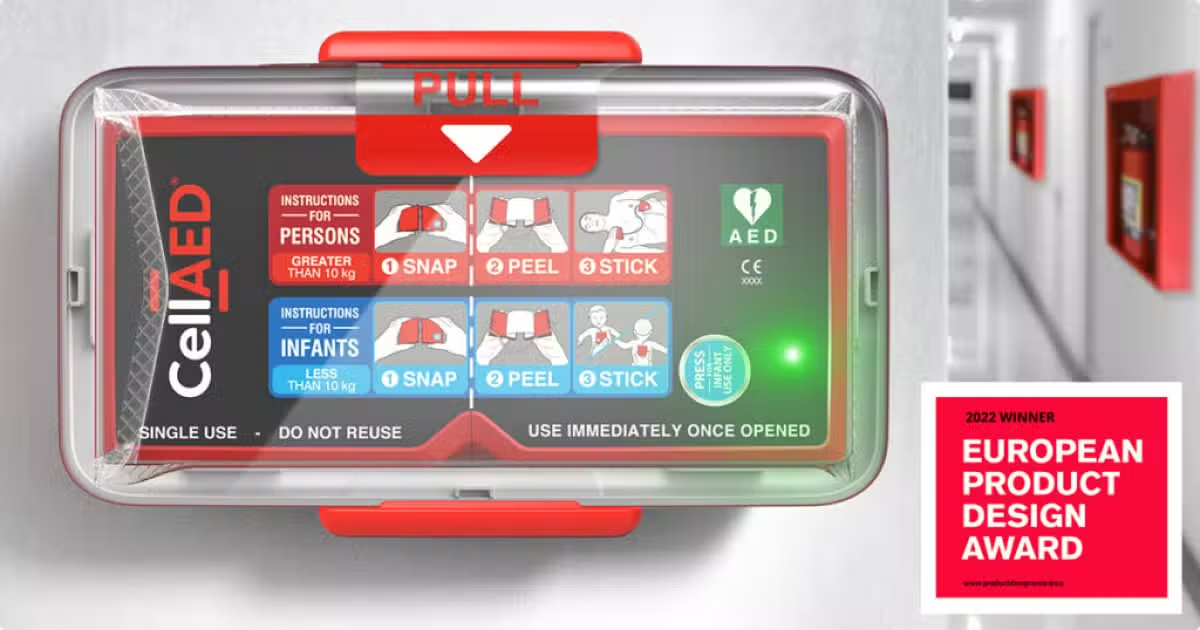
A key challenge in developing the CellAED was ensuring that it could be used by people with little or no medical training.
In emergency situations, stress levels are high and time is critical. The design therefore focuses on clarity, simplicity, and intuitive interaction.
Portability also plays a crucial role. The compact form allows the device to be stored in everyday environments, making it more likely to be available when needed.
The result is a product that bridges the gap between advanced medical technology and real-world usability.
“We’re honoured to have our work awarded with two European Product Design Awards. The recognition reflects our focus on creating medical products that are not only technically advanced, but also accessible and easy to use.”
Recognition at the European Product Design Awards
The CellAED design has been recognised with two European Product Design Awards, highlighting its innovation and impact within the field of medical product design.
These awards acknowledge both the technical achievement and the design approach behind the product, particularly its focus on accessibility and usability.
What This Means for Medical Device Design
The success of the CellAED reflects a broader shift in MedTech.
There is increasing demand for products that move beyond clinical settings and into everyday life. This requires a strong focus on usability, accessibility, and human-centred design.
Design is no longer just about form. It plays a critical role in enabling technology to be used effectively in real-world situations.